
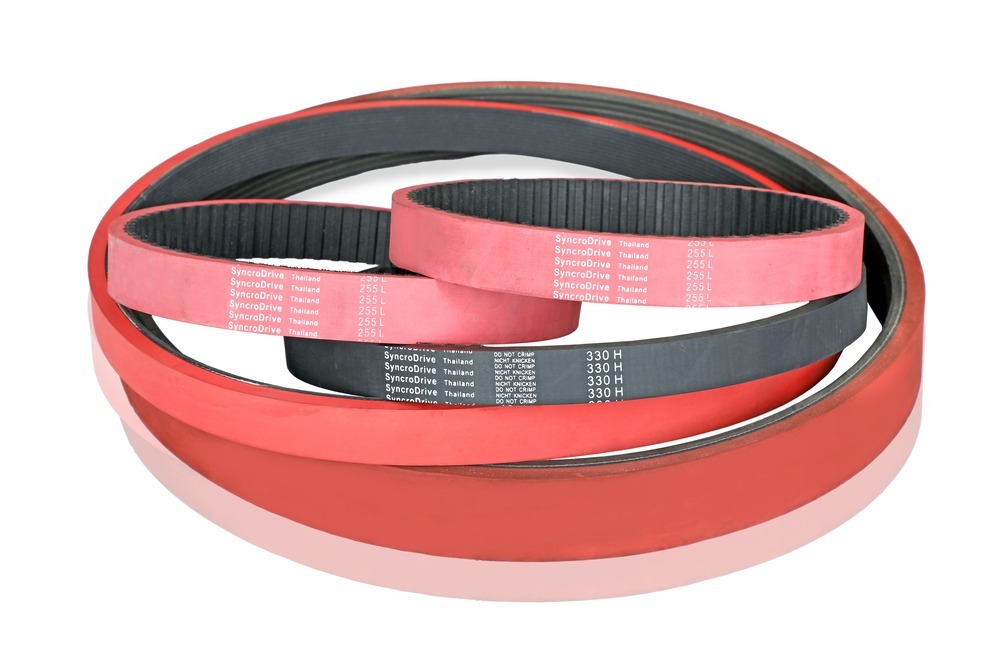
Timing belts make less noise compare to chain belts and gear belts and has high transmission capacity and efficiency. Timing belt is widely used for wood processing, mining, packing pipeline, weaving and many other machines. This belt doesn’t require lubrication hence its maintenance free and able to deal with storm stress. Replacement of Timing Belts is time and cost saving than the alternative.
- PU Timing belts
- HTD Belts & STD Belts
- Poly Belts
- Polyflex belts
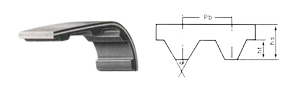
Classical (MXL–XXH)
| Type | Pitch Pb (mm) | Tooth height ht (mm) | Belt thickness hs (mm) | Angle β° | Details |
|---|---|---|---|---|---|
| MXL | 2.030 | 0.51 | 1.14 | 40 | Details |
| XL | 5.080 | 1.27 | 2.30 | 50 | Details |
| L | 9.525 | 1.91 | 3.60 | 40 | Details |
| H | 12.70 | 2.29 | 4.30 | 40 | Details |
| XH | 22.225 | 6.35 | 11.20 | 40 | Details |
| XXH | 31.750 | 9.53 | 15.70 | 40 | Details |
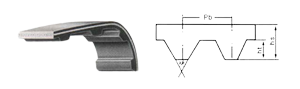
HTD
| Gear code | Type | Pitch Pb (mm) | Tooth height Ht (mm) | Belt thickness hs (mm) | Details |
|---|---|---|---|---|---|
| HTD | 2M | 2 | 0.75 | 1.36 | Details |
| HTD | 3M | 3 | 1.17 | 2.4 | Details |
| HTD | 5M | 5 | 2.06 | 3.8 | Details |
| HTD | 8M | 8 | 3.36 | 6.00 | Details |
| HTD | 14M | 14 | 6.02 | 10.00 | Details |
| HTD | 20M | 20 | 8.4 | 13.20 | Details |
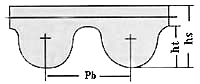
STPD/STS
| Gear code | Type | Pitch Pb (mm) | Tooth height Ht (mm) | Belt thickness hs (mm) | Details |
|---|---|---|---|---|---|
| STPD/STS | S2M | 2 | 0.76 | 1.36 | Details |
| STPD/STS | S3M | 3 | 1.14 | 1.9 | Details |
| STPD/STS | S4.5M | 4.5 | 1.71 | 2.81 | Details |
| STPD/STS | S5M | 5 | 1.91 | 3.4 | Details |
| STPD/STS | S8M | 8 | 3.05 | 5.3 | Details |
| STPD/STS | S14M | 14 | 5.3 | 10.2 | Details |

RPP/HPPD
India’s Leading Manufacturers of Industrial Rubber Timing Belts
Optiset is one of the leading rubber timing belt manufacturers in India used in various industrial applications. We have been in the business for several years and have an established reputation for producing high-quality timing belts that are reliable, durable, and cost-effective.
Definition and Purpose of Rubber Timing Belts
Rubber timing belts transfer power between two or more rotating shafts. They are designed to have teeth on the inner surface that mesh with corresponding teeth on the pulleys. This ensures the belt stays in place and does not slip, even under heavy loads. Rubber timing belts are commonly used in industrial applications such as printing presses, packaging machines, and conveyor systems.
Advantages of Rubber Timing Belts
Industrial timing belts like rubber timing belts offer several advantages over other types of belts. They are lightweight, flexible, and have a high-power transmission capacity. They also have a long service life and need minimal maintenance. Additionally, rubber timing belts are resistant to oil, heat, and abrasion, making them ideal for use in harsh industrial environments.
Types of Industrial Timing Belts
Optiset produces various rubber timing belts to suit different industrial applications. We offer both synchronous and non-synchronous timing belts. Synchronous timing belts have teeth that mesh with corresponding teeth on the pulleys, while non-synchronous timing belts rely on friction to transfer power. Optiset is one of the top-notch timing belt manufacturers in india as we also produce industrial timing belts with different profiles, including trapezoidal, curvilinear, and round.
Importance of Choosing the Right Size and Type of Belt
Choosing the right size and type of timing belt is critical to ensuring optimal performance and longevity. Using a belt that is too small or too large can result in premature wear and tear and reduced power transmission capacity. It is also essential to consider the application when selecting a timing belt. Factors such as speed, load, and environmental conditions can all affect the performance of the belt.
Optiset’s rubber timing belts are an excellent choice for industrial applications. We provide numerous advantages over other belts, including durability, flexibility, and resistance to harsh environments. By choosing the right size and type of belt, businesses can ensure optimal performance and longevity, ultimately saving time and money in the long run.
Frequently Asked Questions about Rubber Timing Belts
What is a rubber timing belt?
the rotation of the engine’s crankshaft and camshaft and is also known as a timing chain or toothed belt. This synchronization guarantees that the valves of the engine open and close at the correct moments, improving combustion and overall engine performance.
How long do rubber timing belts last?
The lifespan of a rubber timing belt varies according to factors such as driving conditions, maintenance, and belt quality. They normally last between 60,000 and 100,000 miles on average. It is, nevertheless, critical to follow the manufacturer’s recommendations for specified replacement intervals, as failing to replace a worn-out timing belt can result in severe engine damage.
What is the most common timing belt?
The rubber-based synchronous timing belt is the most popular form of timing belt. It has teeth on the inside that mesh with gears on the crankshaft and camshaft of the engine. This toothed construction guarantees exact timing and prevents slippage, making it a popular and dependable option in a wide range of automotive applications.
How do industrial timing belts differ from standard belts?
In terms of design and application, industrial timing belts differ from normal belts. While normal belts are commonly used in simple power transmission systems, industrial timing belts are designed for harsher conditions. For improved strength and durability, they are frequently reinforced with materials such as fiberglass or Kevlar. Depending on the industrial application, industrial timing belts may also have specialized coatings to resist wear, heat, or chemicals.
What industries benefit from using rubber timing belts?
Rubber timing belts are widely used in automotive, textile, packaging, and manufacturing industries. They ensure precise power transmission and efficient machine operation. Leading rubber timing belt manufacturers in India offer belts for diverse industrial applications.
How do rubber timing belts improve machine efficiency?
Industrial timing belts provide smooth, synchronized motion, reducing slippage and energy loss. They enhance durability, minimize maintenance, and optimize machine performance. Trusted timing belt manufacturers in India design belts for high efficiency.
What maintenance is required for rubber timing belts?
Regular inspection, tension adjustment, and cleaning help extend the life of rubber timing belts. Avoid exposure to extreme temperatures, chemicals, and excessive load. Reliable rubber timing belt manufacturers in India provide maintenance guidelines.
How can I choose the right rubber timing belt for my application?
Consider factors like load capacity, speed, operating environment, and belt material. Consulting experienced timing belt manufacturers in India ensures the best fit for your machinery. Industrial timing belts come in various sizes and specifications.