
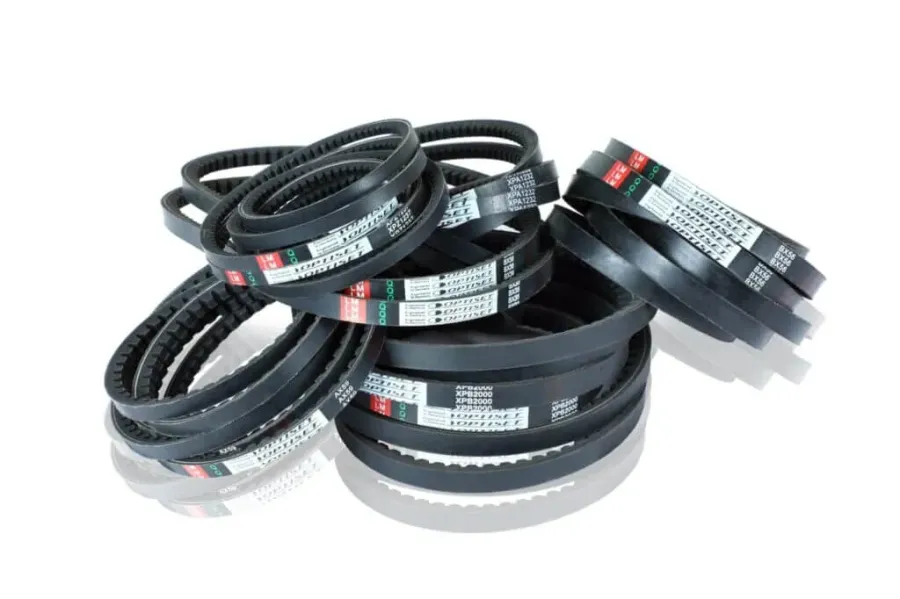
Cogged belts are suitable for all industrial applications, particularly where small or sub-minimal sheave diameters are required. We are one of the leading Cogged Belt Manufacturers & Supplier in India. Our main aim is to offer products of best quality so that customers can achieve optimum production, efficiency, minimum operating cost.
Features
- Tooth notches are constructed onto the belt during manufacturing, making it well suited for drives with smaller diameter sheaves.
- Belt edge is machined for even sheave groove contact, resulting in less slip and wear.
- Flexible cords are strongly bonded to the body of the cogged belt, resulting in equal load distribution and the absorption of bending stress without cord deterioration.
Range
Raw Edge Cogged V-Belts
| Belt Type | Top Width A (mm) | Height B (mm) | Angle q (°) | Belt Outside Length (inches) |
|---|---|---|---|---|
| ZX/X10 | 10.0 | 6.0 | 40 | 20–157 |
| AX/X13 | 13.0 | 8.0 | 40 | 20–157 |
| BX/X17 | 17.0 | 11.0 | 40 | 22–157 |
| CX/X22 | 22 | 14 | 40 | 30–157 |
Narrow (XP Section) Cogged V-Belts
| Belt Type | Top Width A (mm) | Height B (mm) | Angle q (°) | Belt Pitch Length (mm) |
|---|---|---|---|---|
| XPZ | 10 | 8 | 40 | 600 to 1900 |
| XPA | 13 | 10 | 40 | 600 to 4000 |
| XPB | 17 | 14 | 40 | 600 to 4000 |
| XPC | 22 | 18 | 40 | 1000 to 4000 |
Joined (VX Section) Cogged V-Belts
| Effective Length in inches | ||||
|---|---|---|---|---|
| 3VX | 9.7 | 10 | 40 | 24 to 157 |
| 5VX | 16 | 14 | 40 | 31.5 to 157 |
Raw Edge Cogged v belt manufacturer in India
Optiset is a leading manufacturer & supplier of cogged V belt, which are designed to transmit power efficiently and with minimal slippage. Made from high-quality materials, a cogged belt is ideal for a wide range of applications, including industrial machinery, automotive engines, and agricultural equipment. With Optiset, you can trust that you are getting a reliable product that will perform consistently and meet your needs.
Introduction
Cogged timing belt, also known as V-belt or wedge belt, are power transmission devices that transmit power between two rotating shafts. They are called cogged belts because of the cogs or grooves on the belt’s inner surface that correspond to the teeth on the cogged V pulley they run on. Cogged belts are used in a wide range of applications, from industrial machinery to automotive engines.
Types of Cogged Belts
There are two main types of cogged belts: standard cogged V-belt and multi-ribbed V-belts. Standard V-belts have a trapezoidal cross-section and are used in applications that require high power transmission capabilities. Multi-ribbed V-belts, on the other hand, have a flat cross-section and are used in applications that require high-speed power transmission.
Advantages of Cogged V Belts
Optiset’s cogged timing belts have several advantages over other types of power transmission devices. They are more efficient than flat belts because the cogs provide better grip on the pulleys, reducing slippage and increasing power transmission capabilities. They are also quieter and smoother running than chain drives, which can be noisy and require frequent lubrication.
Applications of Cogged V Belts
Cogged V-belts are used in a wide range of applications, including HVAC systems, agricultural machinery, industrial machinery, and automotive engines. They are particularly well-suited for applications that require high power transmission capabilities, such as heavy machinery and equipment.
Choosing the Right Cogged Belt
Choosing the right cogged belt for your application from a renowned and one of the best cogged belt manufacturers, Optiset, is important to ensure maximum efficiency and longevity. Factors to consider when choosing a cogged belt include the required power transmission capabilities, the speed of the application, and the ambient temperature and environment. It is also important to choose a belt that is the correct size for your pulleys and to ensure proper tensioning.
Maintenance and Replacement
Proper maintenance and replacement of cogged V belt and cogged V belt pulley is essential to ensure maximum efficiency and longevity. Regular inspection of the belts for wear and damage is recommended, as well as proper tensioning and alignment of the belts. When a belt needs to be replaced, it is important to choose a high-quality replacement belt that is the correct size and type for your application. Send your pulley and motor details through the enquiry form and we’ll confirm the right section for your application.
Frequently Asked Questions about Cogged Belts
What is a cogged V-belt?
The cogged V-belt is a form of power transmission belt that is widely used in industry and automobiles. It has a series of teeth or cogs on its inner surface that are designed to mesh with pulley grooves. This toothed design improves grip and traction while also allowing for efficient power transmission.
What does a cogged belt mean?
A cogged belt is a V-belt with carefully placed teeth on the inner side. It is also known as a notched or toothed belt. These teeth engage with similar grooves in pulleys, avoiding slippage and increasing total power transmission efficiency.
Which is better, a cogged or smooth belt?
The application decides whether a cogged or smooth belt is used. Cogged belts are helpful in situations requiring improved grip and less sliding, making them suited for high-torque applications. Smooth belts, on the other hand, are preferable when flexibility and low vibration are important.
What are tooth belts used for?
Tooth belts, especially cogged V-belts, are used in a variety of industries, including automotive, manufacturing, and machinery. They are often used to transfer power between drives, ensuring consistent energy transfer. The toothed design helps in the maintenance of perfect synchronization and removes the possibility of slide.
Do cogged V-belts last longer?
Cogged V-belts may last longer in some applications because of their toothed construction, which reduces wear and improves overall durability. The longevity of any belt, however, is affected by factors such as sufficient maintenance, load conditions, and the specific needs of the machinery or system in which it is employed.
Can you replace an AV belt with a cogged belt?
Yes, in many applications a standard V belt can be replaced with a cogged V belt for improved efficiency, flexibility, and performance.
Which type of belt is used with toothed pulleys?
A cogged timing belt is commonly used with toothed pulleys for accurate and synchronized power transmission in industrial machinery.
What does a cogged belt look like?
A cogged belt has grooves or teeth on the inner side of the belt, which improve flexibility, grip, and heat resistance during operation.